The long view
Zemun through the ages: from Taurunum to Belgrade
Seven thousand years on a loess hill: Taurunum, the Habsburg frontier town and the merger of 1934.

Photo Credit
In the area: Café terraces on Magistratski trg in old Zemun. Image courtesy of © Milica Buha · CC BY-SA 4.0 via Wikimedia CommonsZemun has been a Neolithic village, a Roman naval base, a Habsburg frontier town and, since 1934, part of Belgrade. This is the long story, told from the hill of Gardoš down to the quay.
Zemun owes everything to a bank of wind-blown dust. The loess plateau of Gardoš rises safely above the Danube’s floods, and people have been settling on it since the early Neolithic. The municipality’s own history dates the first villages to around 4500–3000 BC; on the line between today’s Orthodox and Catholic cemeteries you can still make out the burnt floors of their houses, sliced through like a layer cake.
Taurunum, the Roman port
The first town we can name is Celtic Taurunum, thought to have been founded around 85 BC on Gardoš. After Rome crushed the Pannonian uprising in AD 12, Taurunum grew into a Roman town and then a fortified port, home to the Roman Danube fleet and a stop on the main road to Constantinople. That made it a prize, and the Huns duly plundered it early in the fifth century.
The name changed with the owners. The Franks called the place Mallevila; by the first half of the ninth century the Slavs were calling it Zemlin, ‘the earthen town’, which is where Zemun comes from. Crusaders of the Second and Third Crusades marched through, and Hungarians and Byzantines took turns building the walls up and tearing them down, sometimes with the same stones.
Hunyadi’s tower and the Ottoman years
In 1456, during the Ottoman siege of Belgrade, a Christian fleet broke a chain of boats near Zemun and came to the city’s rescue under Janos Hunyadi. Plague followed victory, and Hunyadi died of it; the tower of the old fort where he lived has been called Sibinjanin Janko’s Tower ever since. From 1522 Zemun belonged to the Ottoman Sanjak of Syrmia.
The Habsburg frontier
The Treaty of Passarowitz handed Zemun to Austria in 1718, and Austria kept it until 1918. Serbs returned, German craftsmen arrived, and in 1730 the quarantine station opened, a story we tell in full in Zemun’s frontier story. In 1746 the town joined the Military Frontier, the empire’s armed border zone, as a free military community with its own Magistrat.
In 1789, for once in its history, Belgrade was ruled from Zemun.
History then played a joke on its neighbour. When the Austrians took Belgrade in 1789, the mayor of Zemun also ran the city across the river: for once, Belgrade was ‘under Zemun’. The town grew rich on the overland trade between Vienna and Constantinople and spoke several languages, until the closure of the quarantine in 1842 cost it dearly.
Railway, gaslight and a free town
After the creation of Austria-Hungary, Zemun became a free town with an elected mayor in 1871. The railway arrived in 1873, linking it to Europe and, through Belgrade, to the East. Workshops, steam mills, banks and modern hotels followed, along with artesian wells in 1892 and electric street lighting in 1901.
Joining Belgrade
On 5 November 1918, in the last days of the First World War, the Serbian army entered Zemun, and the town became part of the new South Slav state. A bridge over the Sava opened in 1934 and Zemun was joined to Belgrade the same year. Occupied in April 1941, it was liberated on 22 October 1944, and since 1945 it has been one of Belgrade’s municipalities.
Our advice: read Zemun from the top down. Start at Gardoš, where the Neolithic floors and the medieval walls share the hill, walk down past the Habsburg houses of Glavna, and end on the quay, where the Roman fleet once moored. Seven thousand years, one gentle slope.
Why it's on our list
- Neolithic Gardoš and Roman Taurunum
- The Military Frontier from 1746
- A free town in 1871, part of Belgrade in 1934
Location
The map comes from Google Maps, which sets its own cookies once it loads.
More in depth
 The best view over the DanubeZemun & Gardoš TowerGardoš Tower of 1896, with one of the finest views over Zemun, the Danube and Belgrade.
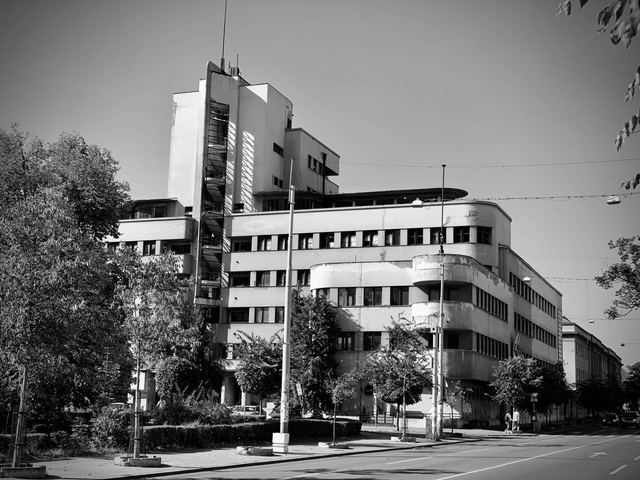 Brašovan’s modernist iconAir Force Command Building, ZemunBrašovan’s 1935 Air Force Command Building in Zemun, a modernist landmark.
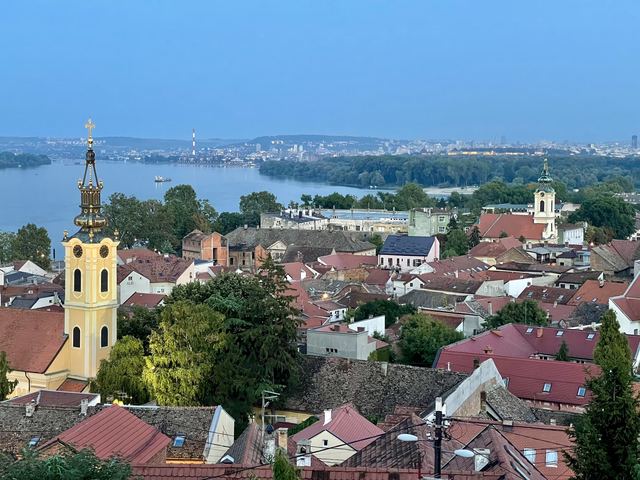 A Habsburg town on the DanubeA walk through old ZemunA little Central European town of Baroque churches and cobbled lanes on the Danube.