Read the façades
Habsburg Zemun in stone: the architecture of the old town
Baroque churches, classicist town halls and a sundial still keeping local time: old Zemun in stone.

Photo Credit
In the area: Café terraces on Magistratski trg in old Zemun. Image courtesy of © Milica Buha · CC BY-SA 4.0 via Wikimedia CommonsOld Zemun is a protected historic core, and its streets read like an architecture textbook from the Military Frontier to the Secession. Here are the buildings, their architects and their dates, from the municipality’s own heritage record.
Old Zemun is listed as a protected historic core, and it repays slow walking. Its streets hold two centuries of Habsburg building, from frontier Baroque to the Secession, mostly on a domestic scale: merchants’ houses, schools, churches and two town halls. The dates below come from the municipality’s record of cultural monuments.
Frontier Baroque
The oldest big building is St Nicholas’ Church, finished in 1752 with all the marks of the Baroque churches of the Military Frontier. Its original bell tower burnt in the great fire of 1867, and buttresses were added by 1870 to steady the walls. The Church of the Nativity of the Mother of God followed, completed largely in 1780 by Serbs, Aromanians and Greeks of the town.
On Veliki trg, the Catholic parish church of the Blessed Virgin Mary went up in 1785–1795 on the site of a converted mosque and was given its Empire-style finish in the mid-19th century. Its parish house dates from 1787. Three faiths, three styles, one short walk.
Merchants’ houses
The Karamata family house on Karamatina 17 began in 1763 as a merchant’s house, gained a storey and a classicist façade in 1827, and in 1788–89 sheltered the Habsburg headquarters of the war against the Ottomans. Ičko’s House of 1793, on Bežanijska, was an inn for travellers, horses and carts before it became a monument.
On Gospodska 6, a Jewish merchant rebuilt his burnt house after the fire of 1788 and set a Latin plaque over the gate: the house was turned to ashes and raised again by God’s help and the owner’s hard work. The year is hidden in the text: add up the large letters and you get 1792. On Glavna 23, the House with the Sundial of 1823 still tells local time from its sundial of 1828, on sunny days only.
Felber and Kapus, the town’s builders
Two local names keep recurring. The builder Josef Felber designed the classicist Old Magistrat on Magistratski trg (1826–1832), the Catholic chapel of St Roch in the old quarantine (1836) and Holy Trinity Church in the Upper Town (1842). Half a century later, town engineer Dragutin Kapus gave Zemun its neo-Renaissance post office on Glavna (1896) and the domed town hall of 1886.
Over the gate, the year of rebuilding is hidden in a Latin riddle: add up the large letters and you get 1792.
That town hall was hit by a bomb on 17 April 1944. It was rebuilt to plans by the Belgrade architect Rajko Tatić from 1946 and extended by 1949, with frescoes in the ceremonial hall and two large mosaics inside.
Schools of the new century
Zemun spent generously on education. The neo-Renaissance Gymnasium, designed by the Zagreb architect Nikola Kolar, opened in 1879. Janko Holjac’s girls’ school followed in 1899 in the City Park. The boys’ school of 1913–14, by Viktor Kovačić and Hugo Ehrlich, with its clock lantern, is one of the finest modern buildings in the town before 1918.
The river and the hill
Against the Danube’s floods, the quay walls were built in 1886–1889, and by the early 1890s the Kej had become the town’s second promenade. Above it all, Hungary raised the 36-metre Millennium Tower on Gardoš in 1896 in a mix of historic styles, to mark a thousand years of the Hungarian state. The Old Customs House of 1781, one of the largest buildings of frontier Zemun, still stands by the river.
Our advice: walk Glavna slowly and look up. The ground floors have changed with every century of shopkeepers; the cornices, pediments and that sundial have not.
Why it's on our list
- Baroque churches of the frontier
- Felber and Kapus, the town’s builders
- Secession schools of 1913–14
Location
The map comes from Google Maps, which sets its own cookies once it loads.
More in depth
 The best view over the DanubeZemun & Gardoš TowerGardoš Tower of 1896, with one of the finest views over Zemun, the Danube and Belgrade.
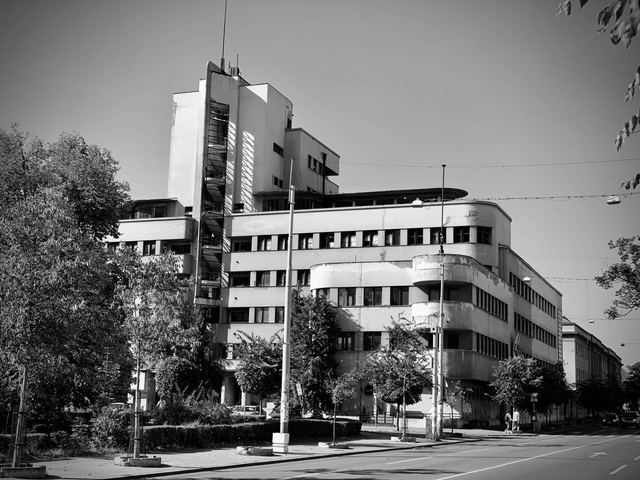 Brašovan’s modernist iconAir Force Command Building, ZemunBrašovan’s 1935 Air Force Command Building in Zemun, a modernist landmark.
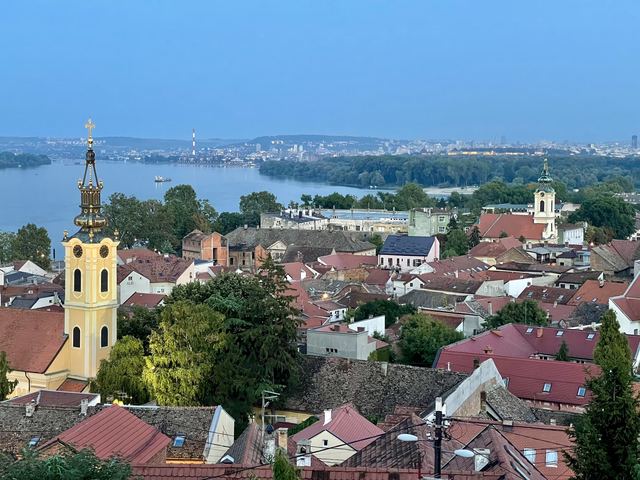 A Habsburg town on the DanubeA walk through old ZemunA little Central European town of Baroque churches and cobbled lanes on the Danube.